
The Yen Carry Trade: Anatomy of a Global Margin Call
Using the August 2024 yen carry trade unwind as a case study in systemic risk — how Japan's post-war economic model created the conditions for a global margin call, and what to watch for next.
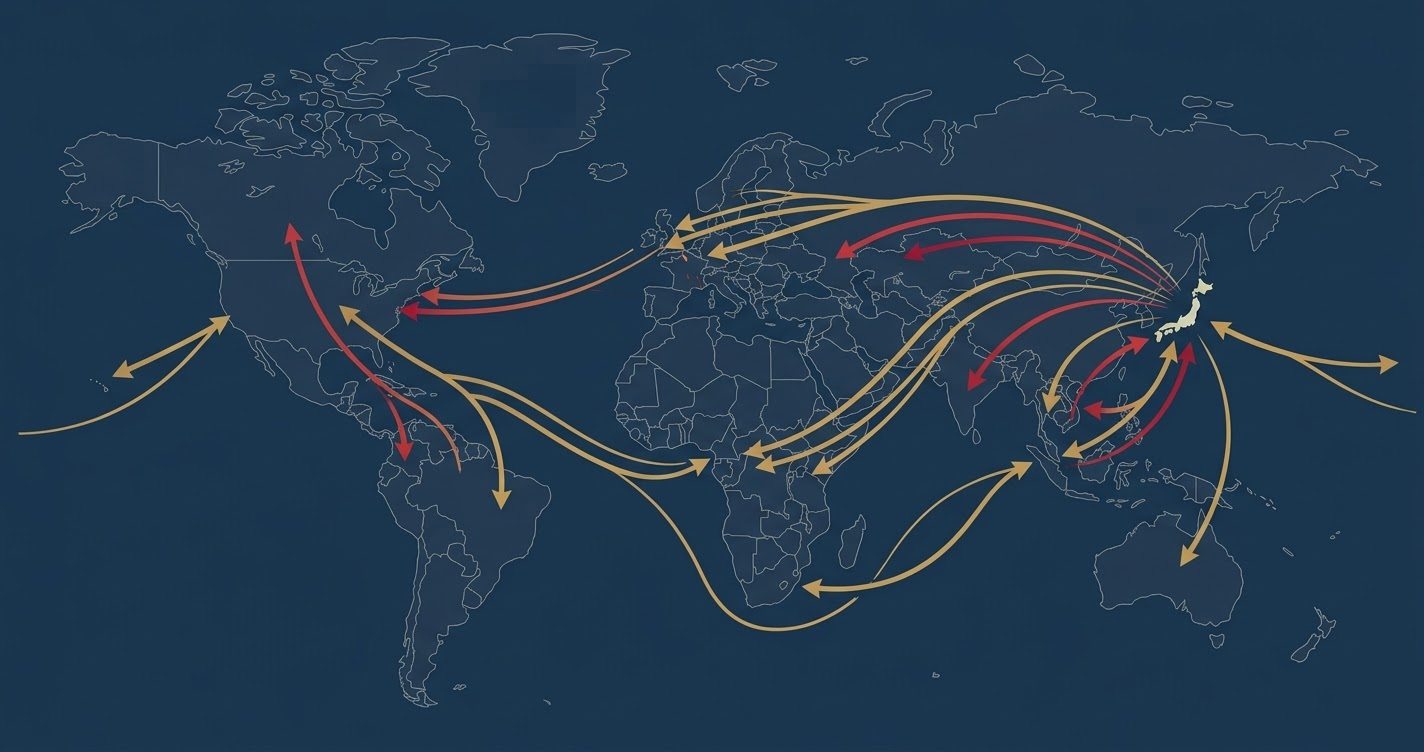
This article was written in the aftermath of the August 2024 yen carry trade unwind, which sent shockwaves across global markets. The motivation is not to explain what happened — the BIS, sell-side desks, and financial media covered that well [1]. The motivation is to understand why it happened — how Japan's post-war economic model, a catastrophic earthquake, three decades of deflation, and a pandemic created the conditions for a global margin call. The goal: understand the plumbing well enough to know when it might break again.
Key ideas in brief
- Japan's post-war export model generated massive USD reserves, most of which were invested into US Treasuries — making Japan the largest foreign holder of US government debt
- Three decades of near-zero rates to combat deflation turned the yen into the world's funding currency, creating a carry trade estimated at $250 billion or more
- The Bank of Japan's July 2024 rate hike — its second in 17 years — collided with a softening US tech trade, triggering cascading liquidations
- USDJPY is the canary in the coal mine: if it falls (yen strengthens), carry trade positions unwind and risk assets face liquidation pressure
How Japan Got Here
The Post-War Model
Japan's post-war economic miracle was built on a simple formula: import raw materials, add sophisticated engineering, export finished products at a premium [2]. Electronics, automobiles, precision machinery — Japan became the workshop of the world before China took that title.
This model generated enormous dollar surpluses. Japanese exporters earned USD, and those dollars needed a home. Per convention, surplus nations invest in the reserve currency's sovereign debt. Japan became — and remains — the largest foreign holder of US Treasury securities, at approximately $1.1 trillion [3].
The export model also created a structural tension in the yen. Japan needed a competitive (weaker) currency to keep exports affordable. But the global demand for Japanese products simultaneously created buying pressure on the yen. For decades, these forces roughly balanced.
The Long Appreciation (1970-2011)
Under Bretton Woods, the yen was fixed at 360 per dollar. After Nixon closed the gold window in 1971, the yen began a four-decade appreciation. By October 2011, USDJPY reached 75.77 — an all-time record for yen strength [4].
That's a 79% appreciation of the yen against the dollar. Japan's exporters managed this through relentless productivity gains, offshore manufacturing, and — when necessary — coordinated intervention by the Ministry of Finance. The yen got stronger, but the economy adapted.
Then the ground moved.
Fukushima and the Pivot (2011-2013)
On March 11, 2011, a magnitude 9.1 earthquake struck 72 km off Japan's Pacific coast — the most powerful earthquake in Japan's recorded history [5]. The resulting tsunami triggered the Fukushima Daiichi nuclear disaster. Damage estimates ranged from the World Bank's $235 billion [6] to broader estimates exceeding $360 billion — making it the costliest natural disaster in recorded history.
Japan needed to spend massively to rebuild. The strong yen, once manageable, became a liability — it made reconstruction imports more expensive and crushed the competitiveness of exporters already struggling with a devastated supply chain.
In December 2012, Shinzo Abe was elected Prime Minister on a platform of economic revitalization. The policies that followed — collectively branded Abenomics — were launched in early 2013 and consisted of three "arrows" [7]:
- Aggressive monetary easing — the Bank of Japan launched massive quantitative easing, eventually introducing negative interest rates (-0.1%) and yield curve control (capping 10-year JGB yields)
- Fiscal stimulus — multiple government spending packages to boost demand
- Structural reforms — deregulation, corporate governance changes, labor market reforms (the least implemented of the three)
The monetary easing was unprecedented in scale. The BoJ's balance sheet swelled to over 100% of GDP as it bought JGBs, ETFs, and REITs. Rates went to zero, then negative. The message was clear: the yen needed to weaken, and the BoJ would do whatever it took.
The Great Depreciation (2012-2024)
The yen responded. USDJPY moved from roughly 76 in late 2012 to 126 by mid-2015 — the yen lost approximately 40% of its dollar value in three years [4].
This first leg of depreciation was set against the backdrop of globally low interest rates post-GFC. Japan was not alone in easing — the Fed, ECB, and BoE were all running accommodative policy. Japan just went further than anyone else.
The yen partially recovered between 2016 and 2020, trading in a 100-115 range as markets stabilized. Then COVID hit.
The pandemic triggered another round of global money printing. But this time, the aftermath diverged. By 2022, inflation had arrived in the US and Europe. The Fed began hiking aggressively — from 0% to 5.25% in eighteen months. The ECB followed. The Bank of England followed.
Japan couldn't follow.
Three decades of trying to escape deflation — with an aging population that structurally suppresses demand — meant Japan still needed loose monetary policy. Its debt-to-GDP ratio, accumulated over those three decades as it tried to recover from the 1989 asset bubble collapse, had risen from approximately 65% to over 250% [8]. Raising rates would dramatically increase debt servicing costs on the world's most indebted developed economy.
So while the rest of the world hiked, Japan held. USDJPY moved from roughly 110 in early 2021 to 162 by July 2024 [4] — the yen lost another 32% of its dollar value, bringing the total depreciation from the 2011 peak to over 53%.
The rate differential between Japan and the rest of the world had never been wider. And the carry trade had never been larger.
The Carry Trade: How It Works
The mechanics are simple. Borrow in a currency with low interest rates (yen, at effectively 0%). Convert to a currency with high interest rates (USD, at 5.25%). Invest the proceeds in higher-yielding assets — US Treasuries, tech stocks, anything with a return above your borrowing cost. Pocket the differential.
As long as two conditions hold, this is free money:
- The interest rate differential persists
- The funding currency (yen) doesn't appreciate against the investment currency (USD)
The yen carry trade has been in operation since the early 1990s, born from the same near-zero rate environment that the BoJ created to fight deflation after the 1989 bubble burst [9]. It gained global prominence during and after the 1997-98 Asian financial crisis, where yen-funded positions in Asian currencies contributed to the contagion when those currency pegs broke.
Since then, the trade has grown structurally. Every year that Japanese rates stayed near zero while the rest of the world offered positive yields, the carry trade accumulated. By 2024, the BIS estimated the outstanding positions at approximately 40 trillion yen — roughly $250 billion [1].
The danger of the carry trade is that it is inherently concave — it generates many small gains (the interest differential) but faces occasional catastrophic losses (when the yen strengthens sharply). This is the opposite of the convex profile we've argued for in previous research. Carry traders are collecting pennies in front of a steamroller.
And in August 2024, the steamroller arrived.
What Happened in August 2024
The Trigger
Two things happened simultaneously.
The BoJ hiked rates. On March 19, 2024, the Bank of Japan ended its negative interest rate policy for the first time since 2007 — raising its policy rate from -0.1% to a range of 0% to 0.1% [10]. This was the first rate increase in 17 years. Markets absorbed it. Then on July 31, 2024, the BoJ raised again to approximately 0.25% [11] — a second hike in five months, signaling that the BoJ was serious about normalization.
US tech wobbled. During the same period, the AI trade that had driven markets higher began showing cracks. The Nasdaq posted several sharp down days in late July and early August. If those positions were funded by yen borrowing — and many were — the decline triggered margin calls.
The Cascade
What followed was a textbook liquidation cascade:
- US tech positions fall → margin calls on leveraged carry trade positions
- Traders forced to sell assets to meet margin → more selling pressure on US equities
- Liquidation proceeds (in USD) converted back to yen to repay yen-denominated loans
- Yen buying pressure → yen appreciates → remaining carry positions lose more on the FX leg
- More margin calls → repeat
The Nikkei fell 12.4% on August 5, 2024 — its worst single-day decline since Black Monday in 1987 [1]. USDJPY plunged from 153 to 142 in days. The VIX spiked above 65.
This was a global margin call, and the yen was the fuse.
The Stabilization
The BoJ moved quickly to contain the damage. On August 7, Deputy Governor Shinichi Uchida signaled that the BoJ would not raise rates further while markets were unstable [1]. This was effectively a verbal put — a promise to stop tightening until the unwind stabilized.
Markets recovered. But the positions hadn't fully unwound. They had merely stopped cascading.
The Pain Threshold: 160 USDJPY
Before the July hike, the Japanese government had already signaled its limits. When USDJPY breached 160 in April 2024, the Ministry of Finance intervened directly in FX markets — selling dollars and buying yen to arrest the depreciation [12].
160 appears to be the pain threshold, and for good reason. Beyond that level, import costs — particularly energy — begin meaningfully eroding Japanese consumers' purchasing power. Japan imports virtually all of its fossil fuels. A weaker yen means higher electricity bills, higher food costs, higher input costs for domestic businesses. With Japan's CPI running at approximately 2.7-3.0% in mid-2024 [13], further depreciation risked turning manageable inflation into a political crisis.
But there may be a second, more systemic motivation for the BoJ to cap the depreciation: managing the unwind on their own terms. In an increasingly volatile world, the BoJ may have decided it was better to trigger a controlled unwind via a rate hike than to wait for global markets to force a disorderly one. If you're going to unwind the carry trade, better to do it when you choose, with your finger on the pause button, than to be at the mercy of a US tech selloff or a geopolitical shock.
The Early Warning: Norinchukin
The cracks appeared before August. In May 2024, Norinchukin Bank — one of Japan's largest agricultural cooperative banks — disclosed significant losses on its foreign bond portfolio [14]. By June, Bloomberg reported the bank planned to sell $63 billion in US and European bonds to stem the bleeding, tripling its initial loss forecast to 1.5 trillion yen.
Norinchukin was the canary. A Japanese institution, heavily invested in foreign bonds funded by yen liabilities, forced to liquidate and repatriate. The same mechanics that would play out across the entire carry trade complex two months later, previewed in a single institution.
The Plumbing: How an Orderly Unwind Might Work
This section is speculative — a framework for thinking about the mechanics, not a description of confirmed events. The infrastructure exists; whether it was used this way is not publicly confirmed.
The problem: The BoJ needs to pull yen out of the global system to reduce carry trade exposure. But doing this too quickly crashes both Japanese and global markets. Meanwhile, Japanese institutions hold trillions in foreign assets (US Treasuries, US equities) that they may need to sell and repatriate.
The US concern: A large-scale sell-off of US Treasuries by Japanese institutions would push yields higher, increasing borrowing costs for the US government. A sell-off of US equities would reduce capital gains tax revenue and dent market confidence. Neither is desirable.
A possible mechanism:
Japan's economy operates with a degree of coordination between its government, central bank, and private sector that is unusual by Western standards. In this context, the unwinding might proceed through managed channels rather than open market sales:
- Japanese banks, pension funds, and corporates gradually sell foreign asset holdings and repatriate funds to yen
- Repatriated yen is used to purchase JGBs — providing buyers for a market that has been hollowed out by years of BoJ purchases under yield curve control
- The Fed and BoJ have standing dollar liquidity swap lines [15], established permanently in 2013. These allow the BoJ to borrow dollars from the Fed using yen as collateral
- The BoJ could distribute dollars to Japanese institutions, allowing them to settle foreign obligations without dumping assets on the open market
- Institutions convert USD to yen through FX markets and buy JGBs, simultaneously strengthening the yen (unwinding the carry trade) and finding domestic buyers for Japanese government debt
The key feature of this mechanism: securities never hit the open market. JGBs find new domestic buyers. US Treasuries and equities are absorbed onto central bank or institutional balance sheets rather than sold into a panicking market. The carry trade unwinds through managed repatriation rather than forced liquidation.
Is this what happened? We don't know. The Fed publishes swap line usage data, and there was no publicly reported material drawdown during August 2024. The BoJ's primary tools appeared to be direct FX intervention and Deputy Governor Uchida's verbal guidance.
But the infrastructure exists. And the next time the carry trade threatens to unwind violently, this is the playbook to watch for.
What to Watch
The August 2024 episode was a warning shot, not the main event. The carry trade has partially unwound but not fully — the structural incentives that created it (near-zero Japanese rates vs. positive global rates) still exist, albeit at narrower differentials.
The key variable is USDJPY. It functions as a real-time indicator of carry trade stress:
- USDJPY rising (yen weakening) → carry trade is stable or growing → risk assets supported by yen-funded flows → equities recover
- USDJPY falling (yen strengthening) → carry trade is unwinding → risk assets face liquidation pressure → equities at risk
This is the simplest heuristic for monitoring systemic carry trade risk.
Factors that could trigger the next unwind:
- Further BoJ rate hikes. The gap between Japanese inflation (~3%) and the policy rate (~0.25%) remains wide. The BoJ has room — and arguably the mandate — to normalize further. Each hike narrows the carry differential and increases the incentive to unwind.
- US rate cuts. The Fed cut rates by 50 basis points on September 18, 2024 [16]. If the cutting cycle continues, the USD leg of the carry trade becomes less attractive, reducing the incentive to hold the position.
- Risk asset correction. Any significant US equity drawdown — AI bubble deflation, recession fears, geopolitical shock — forces margin calls on leveraged carry positions, restarting the liquidation cascade.
- Japanese institutional repatriation. If Japanese banks and pension funds continue to bring capital home (as Norinchukin signaled), the yen strengthens, which pressures remaining carry positions.
- USDJPY approaching 160 again. This appears to be the BoJ/MoF's line in the sand. Expect intervention — verbal or direct — if the yen weakens back to this level.
The carry trade is a feature of the global financial system — one that exists because of a structural mismatch between Japan's monetary policy and the rest of the world. Like any feature, it works until it's abused beyond the architecture's capacity. August 2024 showed us where the breaking point is. The question is not whether it will be tested again, but when.
Bottomline
Japan's yen carry trade is a case study in how decades of monetary policy create systemic risk:
- Post-war export model generated USD surpluses invested in US Treasuries, making Japan the largest foreign creditor of the US government
- 1989 bubble collapse → three decades of near-zero rates to combat deflation → debt-to-GDP from 65% to 250%
- 2011 Fukushima disaster → Abenomics (2013) → aggressive yen depreciation from 76 to 162 USDJPY
- Rate divergence post-COVID → Japan held at zero while the world hiked → carry trade ballooned to ~$250 billion
- August 2024 → BoJ's second rate hike in 17 years collided with a wobbling US tech trade → cascading liquidations → Nikkei's worst day since 1987
The trading heuristic: USDJPY is the canary. If it goes up (yen weakens), carry trade continues and risk assets are supported. If it goes down (yen strengthens), carry positions unwind and risk assets face liquidation pressure. Watch the rate differential, watch Japanese institutional flows, watch the 160 level.
The carry trade hasn't fully unwound. The structural conditions that created it persist. August was the preview. The feature is still running on architecture that's straining under the load.
Sources
[1] Aquilina, M., Lombardi, M.J., Schrimpf, A., and Sushko, V. "The Market Turbulence and Carry Trade Unwind of August 2024." BIS Bulletin No. 90, Bank for International Settlements, August 27, 2024.
[2] "Economy of Japan." Britannica Money.
[3] "Which Countries Own the Most US Debt?" USAFacts, based on US Treasury data. Japan held approximately $1.06 trillion as of late 2024.
[4] "Dollar Yen Exchange Rate — Historical Chart." Macrotrends. USDJPY from 360 (Bretton Woods) to 75.77 (October 2011 low) to 161.95 (July 2024 high).
[5] "M 9.1 — 2011 Great Tohoku Earthquake, Japan." U.S. Geological Survey. Moment magnitude 9.1, epicentre 72 km east of the Oshika Peninsula.
[6] "Japan Earthquake and Tsunami Caused Up to $235 Billion in Damages, World Bank Says." The Washington Post, March 21, 2011.
[7] "Abenomics." Wikipedia. Launched in early 2013 under PM Shinzo Abe (took office December 26, 2012). Three arrows: monetary easing, fiscal stimulus, structural reforms.
[8] "Japan Debt to GDP Ratio — Historical Data." Macrotrends. Rose from approximately 65% in 1989 to over 250% by 2020.
[9] "The Quiet Engine of Global Risk." Mesirow. History and mechanics of the yen carry trade from the 1990s onward.
[10] Bank of Japan, Monetary Policy Decision, March 19, 2024. Ended negative interest rates for the first time since 2007, raising from -0.1% to 0%-0.1%.
[11] Bank of Japan, Monetary Policy Decision, July 31, 2024. Raised policy rate to approximately 0.25%.
[12] "Japanese Yen." Wikipedia. Covers historical exchange rates and Ministry of Finance FX interventions.
[13] "Japan Inflation Rate." RateInflation. Japan CPI: June 2024 (2.9%), July 2024 (2.7%), August 2024 (3.0%).
[14] "Japan's Norinchukin Bank to Sell More Than 10 Trillion Yen in US, European Bonds." Reuters, June 19, 2024.
[15] "Central Bank Liquidity Swaps." Board of Governors of the Federal Reserve System. Standing swap lines established permanently in October 2013.
[16] Federal Reserve, FOMC Statement, September 18, 2024. Federal funds rate reduced by 50 basis points to 4.75%-5.00%.
Disclaimer: Altus Labs is not authorised or regulated by the Financial Conduct Authority (FCA). Altus Labs is a research publication and this content is provided for informational and educational purposes only. It does not constitute investment advice, a financial promotion, or an invitation to engage in investment activity. See our full disclaimer for more information.